When Marketers Become Publishers…
But first, some winter-wear vocab fun. Is it a cowl? A sontag? A balaclava? Test your mettle below.

Balaclava vs. Sontag vs. Cowl

Claire Fraser from Outlander, Maeve pre-snow play, and me breaking out my fave cowl.
New Outlook, New Structure
OK, remember a while back when I wrote about the 95-5 Rule? Quick refresher, this means most of your customers exist in the future. Ergo, most people are not going to buy from you today. When this is true, marketing is no longer about selling more today. It’s about earning mental availability for tomorrow. This fundamental mindset shift has dramatic ramifications on the structure (and budget) of marketing organizations. If we essentially have a sales cap on the number of conversions we can make at any given time, and our focus needs to be on serving a majority of potential future customers, then we should think of ourselves more as publishers and educators than as marketers.
Look around your marketing organization – does it resemble a publisher? How many editors can you count? How many authors and writers? What’s your publishing schedule? What does content look like on your site? In your owned social channels? Do you publish podcasts? Videos? Workshops? Webinars?
Marketing orgs of the future will increasingly resemble publishers, with editorial calendars, story pipelines, talent with journalistic or academic backgrounds, and KPIs tied to audience development—not just funnel performance. With each passing month and year, the gap between education, entertainment and marketing narrows. In fact, my spiky POV is that good marketing is actually education.
If our emphasis becomes nurturing future customers versus selling more bananas today, and the path to that future is to consistently deliver helpful, engaging educational content, our current marketing organizations will fall flat.
Implications for Marketing Budgets, Talent & Systems
If marketing becomes education and earning mental availability, then:
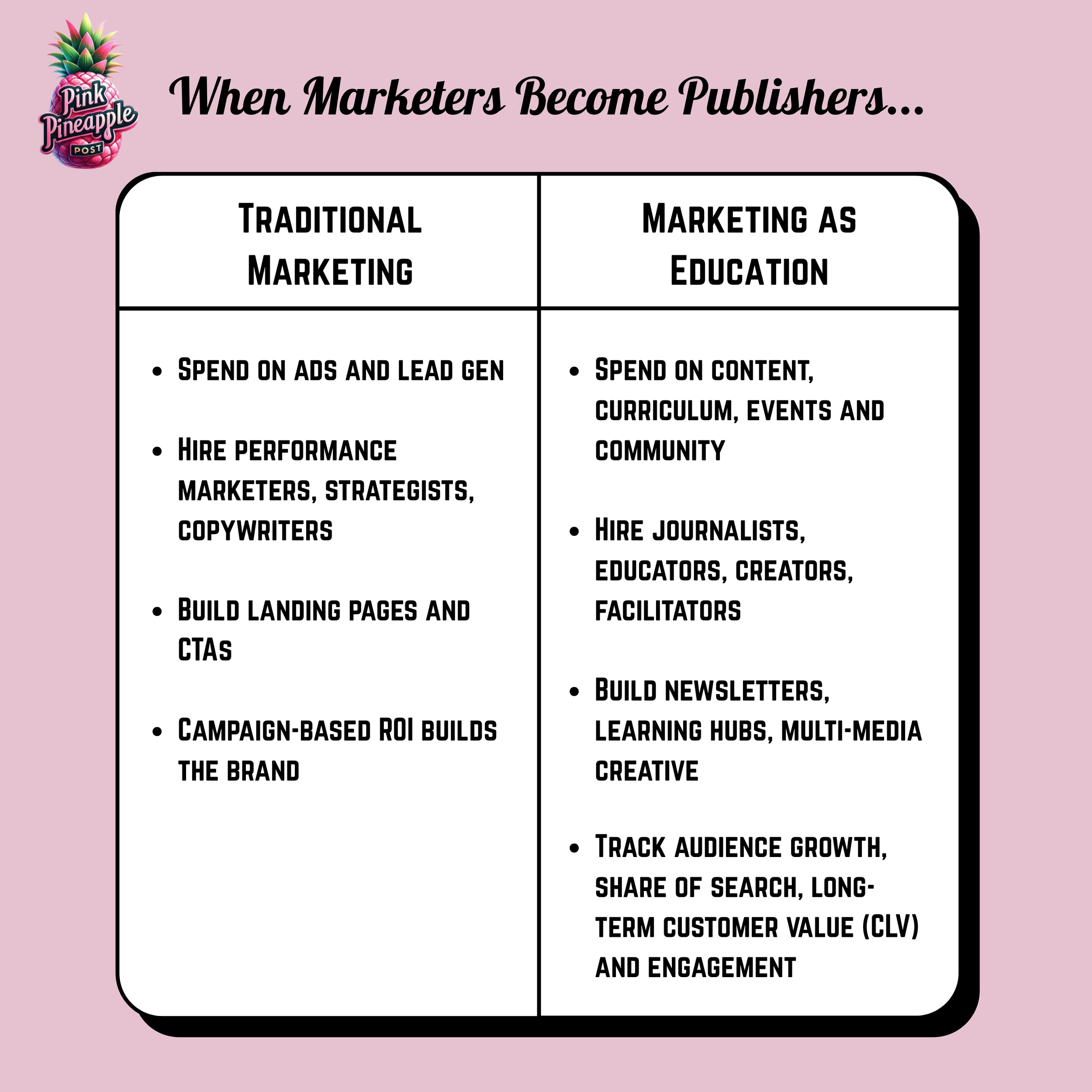
To support this new model, marketing teams must adopt the structure and cadence of a media organization:
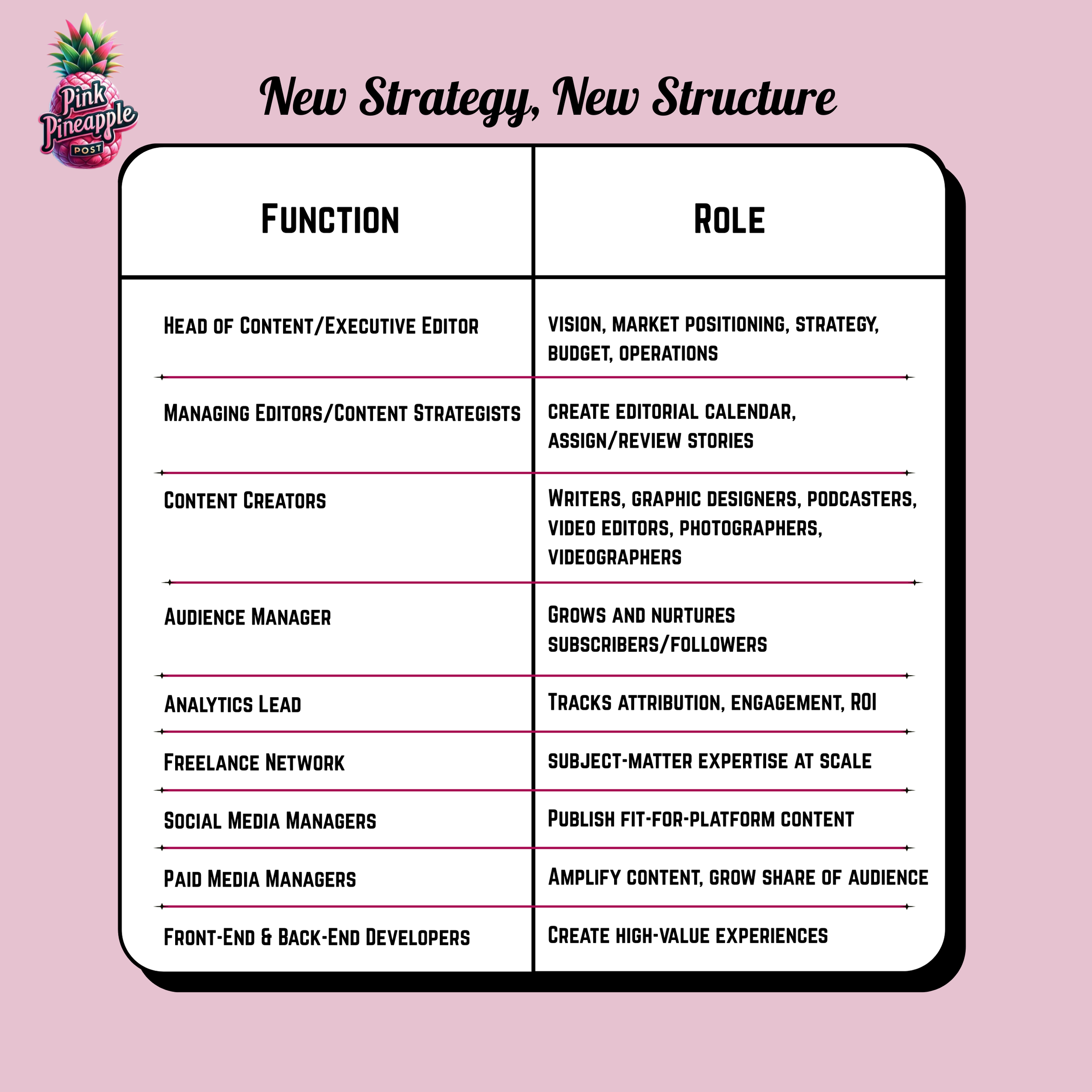
Key Practices
Sometimes life has a funny way of coming full circle, and this next part feels a bit like going back to the beginning for me. One of my first internships was at Indianapolis Monthly Magazine, a glossy city mag with a bustling editorial and photography staff. I vividly remember sitting in the crowded conference room for the weekly pitch meetings. I’m not sure I ever worked up the courage to contribute an idea, but those processes and ways of working offer a meaningful framework for transforming a marketing org into an effective publisher of content for future customers.
Weekly editorial meetings keep ideas fresh and shape angles, inviting varied voices to the table (or Teams call)
Content calendar maintained with a mix of long-term, medium-term and quick-turn pieces (a regular, rolling publishing cadence)
Evergreen content mixed with timely thought leadership, with an eye toward recurring seasonality and following trendlines (only daily cycles can be truly trendy and of-the-minute)
In-house + freelance mix for agility and authority, where assignments can flow to the right match in terms of expertise, time and sources
Mindset Shift to Memory Links
Of course, before you can get to a content-focused structure, leaders need to champion the idea that your audience is made up of many who aren’t going to buy anytime soon. But that doesn’t mean they aren’t worth significant investment. Moving to a publisher mindset works by building and refreshing memory links to the brand. These memory links activate when buyers do come into the market. So, if your advertising is better at building brand-relevant memories, your brand becomes more competitive. Interactions and impressions, accumulated over time, affect our memories. So, your marketing (including educational content) has to be designed to create distinct impressions about your brand in people’s minds—to be activated later.
To grow a brand, you need to connect with people who aren’t in the market now, so that when they do enter the market your brand is familiar. And, that they mentally associate your brand with the need or buying situation that brought them into the market (the pain point they need to solve). That way, you increase buyers’ purchase propensity. And if you can do that across enough buyers, your market share will grow.
Feeling Grateful…
Through a content-focused lens, here are 7 things that keep me filled up and able to keep creating.
Encouragement. If you have taken time to shoot me an email or a text, or mention to me in person that what I’ve written was interesting, useful or made you think about something in a new way, THANK YOU. If you have commented on a LinkedIn post, wowza—please know that you’ve made my entire day. Ditto for those of you who have met me for coffee, Google Meet video calls and Teams talks to discuss ideas and dreams. For me, this all adds up to exactly the encouragement that’s vital for me to keep going.
House of Guinness and K-Pop Demon Hunters. Wildly different genres? 100%. Both amazingly told stories with compelling characters and fresh new voices? Check and check. If you know me, you know excellent content revs my engine. On that credential, I whole-heartedly recommend adding both of these to your streaming diet.
My brain (and yours, too). Oh three-pound mass of gray matter between my ears, how little I have appreciated you through the years. All this reading about the mind has me looking at mine in completely new ways. There’s a lot going on in there, let’s just say.
Writers. Spending time with authors through multiple books has this funny way of making me feel connected to the writer. This year, feeling especially grateful to have spent time with Louise Erdrich, Yuval Noah Harari and Matt Haig.
Journaling. My journal is my private space to hash things out, be that ideas, emotions, even very practical planning matters. Sometimes I draw, sometimes I copy down a quote. Sometimes I glue random snippets to a page. It makes my thoughts more real to me, and it feels like it brings me closer to who I want to be. I’m grateful I’ve established a habit.
Generalist World. I’ve never been a big joiner, but in Generalist World I’ve found a sense of community I didn’t even realize I had been craving. This eclectic collection of so-called generalists feels like my tribe. It’s heartening to be part of such a thoughtful group of individuals, always ready to connect, share and create the future.
Canva. From resumes and portfolios to blog headers, birthday invitations and Christmas cards, this is my go-to tool when I want to think visually. It makes me feel smart and able to translate my thoughts into strong visuals that look polished and professional
Ready to talk content strategy? Email me at jessica@pinkpineapplepost.com or DM me on LinkedIn.